


Surge protection and Uninterruptible Power Supplies (UPS) serve crucial functions in safeguarding electronics. Surge protectors shield devices from voltage spikes caused by events like lightning strikes, redirecting excess current with Metal Oxide Varistors (MOVs). Conversely, UPS devices provide backup power during outages using internal batteries, critical for essential equipment. While surge protectors are typically affordable, UPS systems accommodate higher loads and guarantee continuity during power fluctuations. Understanding these distinctions is fundamental for informed equipment protection choices, and more insights await.
Key Takeaways
- Surge protectors guard against voltage spikes from external events like lightning strikes, diverting excess current to protect devices.
- UPS devices provide backup power during outages, ensuring continuous operation of connected equipment and preventing data loss.
- Surge protectors are ideal for non-critical devices, while UPS systems are essential for critical equipment that requires uninterrupted power.
- UPS units regulate voltage fluctuations, offering stabilization and protection against potential damage, unlike surge protectors that only focus on overvoltages.
- Combining surge protection with a UPS yields comprehensive safety for sensitive electronics, ensuring both surge management and power continuity.
Understanding Surge Protection
Surge protection is a critical aspect of safeguarding electronic devices, particularly in environments prone to electrical disturbances. Surge protectors are specifically designed to shield against voltage spikes caused by events like lightning strikes, redirecting excess current away from sensitive devices using components such as Metal Oxide Varistors (MOVs). These devices do not offer backup power during outages; their primary function focuses on managing instantaneous overvoltages to prevent damage. It is essential to connect surge protectors directly to the main supply wall outlets to optimize functionality; connecting them through devices like UPS can hinder performance. The effectiveness of surge protectors is quantified in Joules, with higher ratings signifying enhanced energy absorption capabilities and protection for sensitive devices. For optimal device protection, experts recommend selecting surge protectors with high joule ratings of at least 2700 Joules to defend against significant voltage spikes.
What Is a Power Surge?

A power surge, which occurs when there is a sudden increase in voltage, can arise from a variety of sources, including lightning strikes, power restoration after outages, and faults in electrical equipment. These surges typically last less than a second but can reach up to 1,000 volts, posing significant risks to electronic devices. Protection against power surges is critical; they can instantly damage electronics by melting metal components or frying circuits, rendering them inoperable. Signs of a surge may include buzzing sounds from outlets and scorch marks on wall sockets. A surge protector or a UPS (uninterruptible power supply) can provide essential protection to safeguard valuable devices against the unpredictable nature of power surges. For optimal protection against power surges, experts recommend using surge protectors rated for at least 790 joules of surge absorption capacity.
Types of Power Surges

Power surges can be classified into several distinct types, each originating from various internal and external sources. External power surges are commonly triggered by lightning strikes, capable of generating voltage spikes over 1,000 volts, resulting in significant damage to connected devices. Conversely, internal sources like high-power appliances can create voltage fluctuations that may affect sensitive electronics. Events such as utility grid switching can also manifest as sudden overvoltages. Although the average duration of a power surge is less than a millisecond, this brief period can cause irreparable harm if protective devices like surge protectors are not utilized. Signs of power surges may include buzzing sounds near outlets or scorch marks, indicating potential risks to any connected power supply during outages. For optimal protection against power surges, using equipment rated between 80W to 120W RMS ensures proper power handling and equipment safety.
How Surge Protectors Work
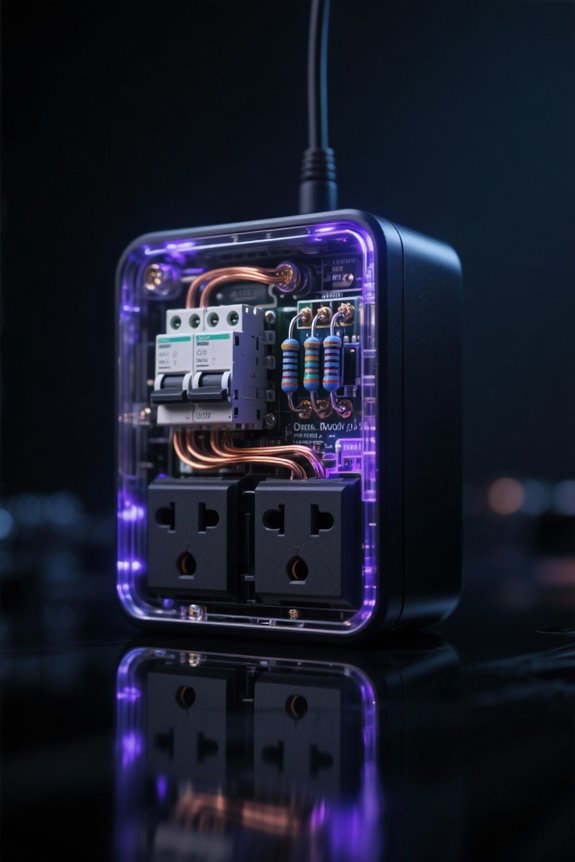
While understanding how surge protectors work might initially seem intimidating, grasping their function is essential for safeguarding electronic devices. Surge protectors divert excess voltage away from connected equipment using components like Metal Oxide Varistors (MOVs) during power surges. They absorb energy, shifting to a conductive state only when a surge occurs, maintaining a high-resistance state otherwise. Typically, they shield sensitive electronics with a clamping voltage no higher than 400 volts. Protection capacity is often measured in Joules, which decreases after repeated use. Some surge protectors also feature built-in indicators to display their operational status and alert users to potential failures. By ensuring effective Voltage Regulation, these devices play a key role in preventing damage to critical electronics. Quality surge protectors should have surge protection ratings between 1800 to 2700 joules for optimal device safeguarding.
Key Features of Surge Protectors

Surge protectors possess several key features that are vital for ensuring the longevity and safety of connected devices. They are designed to absorb and divert excess voltage spikes, utilizing components such as Metal Oxide Varistors (MOVs). The Joule rating indicates the amount of energy they can absorb—higher ratings mean better protection. For effective safeguarding of sensitive electronics, the clamping voltage should not exceed 400 volts. Many models also include an indicator light, signaling whether they are operational and providing protection against surges. Similar to how polling rate affects keyboard responsiveness in gaming, surge protectors‘ reaction time is crucial for protecting connected devices. Remember, surge protectors do not offer backup power during outages or protect against sustained voltage dips; their primary function is to respond to instantaneous overvoltages. In conclusion, effective surge protection is vital for device longevity.
Understanding UPS Devices
An Uninterruptible Power Supply (UPS) serves as an essential safeguard for electronic devices during power outages, ensuring that they remain functional when the electricity fails. UPS devices provide immediate backup power using internal batteries, supporting high-demand electronics like computers or servers with power ratings over 1000 watts. Beyond backup power, UPS systems help regulate voltage, protecting sensitive electronics from voltage fluctuations and power quality issues. They commonly integrate surge protection features, combining these important functions into a single unit. Different types of UPS, such as Standby, Line-Interactive, and Double-Conversion, cater to various environments, effectively streamlining power management and enhancing overall safety. Don’t get me wrong—investing in a quality UPS is essential for safeguarding your technology. Much like modern HDMI capture cards, UPS devices are designed with plug-and-play functionality to provide seamless operation without requiring complex software setups.
How UPS Works
Understanding how a UPS operates is fundamental for effective power management. A UPS (Uninterruptible Power Supply) works by converting incoming AC power to DC via a rectifier, storing it in an internal battery for use during power outages. When power fails, the UPS instantly switches to battery mode, employing an inverter to revert DC power back to AC, ensuring continuity for connected devices. Additionally, the UPS incorporates Automatic Voltage Regulation (AVR) to stabilize output voltage during minor fluctuations, thereby securing equipment from potential damage. Surge protection devices integrated within UPS units redirect excess voltage away from connected electronics, making them essential for protecting against sudden spikes. Various UPS types, including Standby, Line-Interactive, and Online, cater to diverse power management needs. Similar to modern gaming battery packs, UPS systems include smart IC chips for comprehensive protection against overcharging, overheating, and short circuits.
Key Benefits of UPS
While many users may overlook the critical importance of an Uninterruptible Power Supply (UPS), the benefits it offers are crucial for maintaining operational continuity. A UPS provides immediate backup power during outages, guaranteeing that sensitive devices remain operational and preventing data loss from sudden power loss. With features like Automatic Voltage Regulation (AVR), it delivers voltage protection, keeping output stable even amidst fluctuations. This capability is essential for computers and servers, allowing for safe shut down without compromising data integrity. In addition, high-quality UPS systems, especially those with true sine wave output, guarantee compatibility with a broader range of equipment, offering both surge protection and backup power, making them indispensable in environments reliant on electronic stability. Similar to how error-correction technology enhances data integrity in modern storage devices, UPS systems provide essential protection against power-related data corruption.
Core Differences Between Surge Protectors and UPS
The choice between surge protectors and Uninterruptible Power Supplies (UPS) has significant implications for equipment safety and operational reliability. Surge protectors primarily divert excess voltage generated by transient overvoltage events, such as voltage spikes, protecting non-critical devices without offering backup power. In contrast, UPS systems provide surge protection alongside battery backup, ensuring that critical devices remain operational during power outages. While surge protectors operate in a ‘high resistance’ state, UPS units actively store and convert power for uninterrupted use. Typically more affordable than UPS units, surge protectors are adequate for less sensitive equipment, but sufficient protection for sensitive devices often necessitates a UPS. Ultimately, the distinction lies in that surge protectors focus solely on voltage spikes, whereas UPS systems also emphasize power supply continuity. Modern UPS systems can deliver 112W max output to efficiently charge multiple devices while maintaining protection against power fluctuations.
Which Devices Need Surge Protectors?
Selecting the right devices to pair with surge protectors is crucial for safeguarding electronics from unexpected voltage fluctuations. Sensitive devices, such as computers and televisions, are particularly vulnerable to voltage spikes and should always utilize surge protection. Home appliances like refrigerators or microwaves contain electronic components that can easily be damaged by surges. Additionally, medical devices, including CPAP machines and oxygen concentrators, rely on stable power and consequently benefit from surge protectors to guarantee functionality during electrical disturbances. Office equipment such as printers and scanners also requires surge protection to prevent costly repairs or replacements. Connecting these devices to surge protectors maximizes their lifespan and operational reliability, providing peace of mind in an increasingly digital world. Similar to how anti-slip silicone grips protect gaming controllers from damage during intense gameplay, surge protectors shield electronic devices from potentially harmful power fluctuations.
Which Devices Need a UPS?
What factors determine the need for a UPS in your workspace? Organizations should assess the types of devices that require protection during power interruptions. Sensitive equipment, such as desktop computers, servers, and network systems, necessitate a reliable UPS to avoid data loss and guarantee functionality during outages. Additionally, medical devices like CPAP machines and life support systems are crucial and require uninterrupted power for patient safety. High-performance gaming rigs need UPS backup to protect against data corruption from sudden failures. Workstations involved in data-heavy tasks and networking devices, like routers and switches, also benefit considerably from UPS protection, maintaining connectivity and stable operations. Incorporating a UPS is therefore essential for safeguarding essential devices in today’s technology-centric environment.
Combining Surge Protectors and UPS
While many users rely solely on uninterruptible power supplies (UPS) for protection against power issues, integrating surge protectors into their setup greatly enhances overall device safety. This combination offers a thorough protection strategy against both power surges and outages, allowing devices to maintain continuous power supply during fluctuations. For best performance, connect the UPS directly to an outlet, then plug the surge protector into the UPS. Utilizing endpoint surge protection devices with a Joule rating of at least 1000 safeguards sensitive electronics from power surges even after the UPS provides backup power. High-quality surge protectors also help prolong the life of a UPS by reducing the burden of intense surges. Confirm compatibility with the wattage and specifications of connected equipment for effective protection.
Best Practices for Using Surge Protectors and UPS
Implementing best practices for using surge protectors and UPS devices is vital for maximizing the safety and efficiency of sensitive electronics. Surge protectors should always be used with devices vulnerable to voltage fluctuations, as they absorb excess voltage to prevent damage. When utilizing a UPS (Uninterruptible Power Supply), confirm it is directly plugged into a wall socket to avoid overload and maintain surge protection efficiencies. For ideal results, connecting a UPS downstream of a surge protector is advisable, which allows for reliable battery backup. Regular checks on the joule rating of surge protectors are significant; replacement is necessary after multiple surge incidents to sustain protection. Finally, confirm both devices are in well-ventilated environments to prevent overheating, following these best practices.
Connection Guidelines for Surge Protectors and UPS
To maximize both performance and protection of sensitive electronics, understanding the connection guidelines for surge protectors and UPS devices is essential. The recommended order for enhanced protection is Main Power → UPS → Surge Protector → Terminal Devices, ensuring effective power management and surge protection. It’s important not to plug a surge protector into a UPS, especially with high-wattage systems, as this can overload and damage the UPS. UPS units should be connected directly to wall sockets, while surge protectors work downstream, shielding terminal devices from voltage spikes. Following these connection guidelines is significant; incorrect connections can compromise performance and protection, reducing the effectiveness of both surge protectors and UPS, ultimately jeopardizing valuable electronic equipment.
Evaluating Your Power Protection Needs
How can one accurately determine their power protection needs? Evaluating whether to use surge protectors or a UPS (Uninterruptible Power Supply) hinges on identifying potential risks to sensitive electronics. Surge protectors defend against instantaneous voltage spikes, but they lack backup power. In contrast, a UPS guarantees continuous operation during outages while providing voltage regulation, essential for environments facing frequent power fluctuations. For high-value devices, opting for dual protection becomes vital; using both a surge protector and a UPS mitigates risks of operational disruptions and data loss. As a rule of thumb, if power fluctuations average more than five per month, a robust UPS should be considered alongside quality surge protection devices to maintain systems reliably.
Frequently Asked Questions
What Is the Difference Between UPS and Surge Protectors?
The difference between UPS and surge protectors lies in their functionality: UPS features provide backup power during outages and stability, while surge protector features safeguard against voltage spikes, with varying device compatibility and price in different usage scenarios.
What Does UPS Protect Against?
UPS functionality guarantees power backup during outages, guards against voltage spikes, enhances battery longevity, aids runtime estimation, accommodates diverse equipment compatibility, and necessitates regular maintenance requirements for peak performance in critical environments.
What Should You Never Plug Into a Surge Protector?
One should never plug high-wattage devices, medical equipment, or major appliances into a surge protector due to overload risks, potential fire hazards, and compatibility issues, which can jeopardize equipment lifespan and void device warranties.
What Does a Surge Protector Protect Against?
A surge protector functions to shield devices against electrical surges, voltage spikes, and power fluctuations. Ensuring device compatibility and adhering to installation tips can extend surge protector lifespan, enhancing protection for cherished electronics.


