


LED strips come in various SMD densities and brightness levels. For instance, SMD 5050 strips produce 700 to 1000 lumens per meter, while SMD 3528 strips offer just 8-10 lumens per chip. Higher densities, like 120 LEDs/m, enhance brightness and are ideal for task lighting. SMD 2835 and newer 3014 or 3020 chips provide improved efficiency and color accuracy. Don’t get me wrong, knowing these specs helps in selecting the right fit—there’s much more to explore on this topic.
Key Takeaways
- SMD 5050 strips produce 700–1000 lumens/m and are versatile for bright, color-changing applications.
- SMD 3528 strips offer lower output at around 80-120 lumens/m, suitable for softer, indirect lighting.
- Higher-density strips, such as 120 LEDs/m, enhance brightness and are ideal for task or architectural lighting.
- SMD 5630 LEDs deliver about 160 lumens per chip, making them preferred for commercial lighting needs.
- Newer SMD chips like 3014 and 3020 improve efficiency and brightness while supporting better thermal management.
Understanding SMD Density in LED Strips
SMD density plays an essential role in determining the performance and application of LED strips. Measured in LEDs per meter, higher density options—such as 120 LEDs/m—significantly enhance brightness and light output. For example, a typical 60 LEDs/m 5050 strip produces 700 to 1000 lumens/m, while a high-density 120 LEDs/m 2835 strip outputs over 1800 lumens/m, greatly improving visual uniformity. However, increased SMD density also results in higher power consumption; where a 60 LEDs/m strip consumes about 4.8W/m, a 120 LEDs/m variant may exceed 9.6W/m. This necessitates the use of appropriate power supplies and enhanced thermal management to prevent overheating. Don’t get me wrong—understanding these factors is critical for ideal LED strip performance. Similar to how STELLAR.45 drivers enhance audio fidelity in high-end gaming headsets, increased LED density delivers superior visual performance in lighting applications.
Brightness Levels Across Different SMD Types

While evaluating brightness levels is essential for selecting the right LED strip, understanding how different chip types influence light output can greatly impact your decision-making process. SMD 5050 LEDs, with their three diode configuration, typically offer around 120 lumens per chip, making them ideal for color-changing applications. In contrast, SMD 3528 LEDs produce only 8-10 lumens each, best for softer lighting needs. SMD 2835 LEDs provide a range of 80-100 lumens, suitable for both residential and commercial lighting use. The standout, SMD 5630, achieves approximately 160 lumens per chip, making it a top choice for commercial lighting. Additionally, higher-density strips, like 120 LEDs/m, deliver superior brightness output compared to standard 60 LEDs/m options, enhancing overall efficiency and illumination. Modern battery-powered LED strips can maintain consistent brightness levels for up to 50,000 hours when properly configured with appropriate power sources.
Comparing 3528 LED Strips With 5050 LED Strips
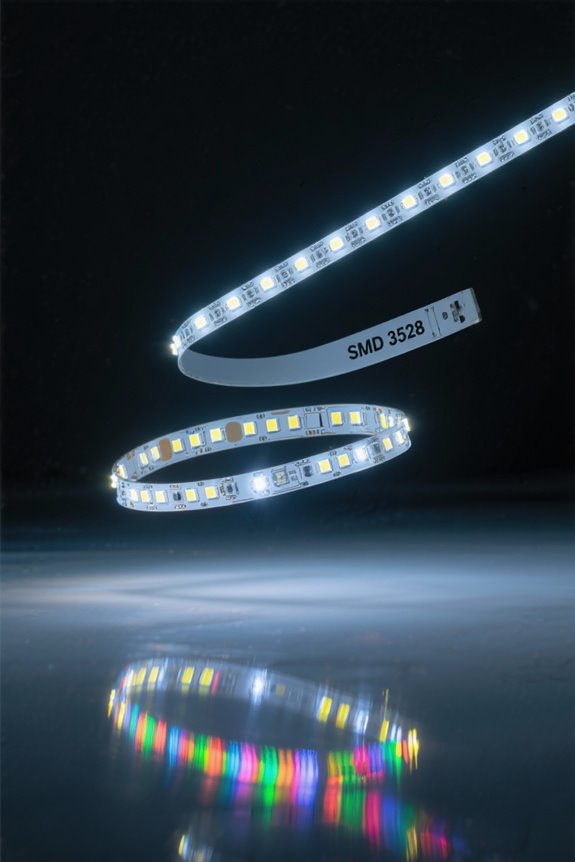
When evaluating LED strip options, one can clearly see the differences between 3528 and 5050 models, as both serve distinct purposes in lighting applications. SMD 5050 strips, equipped with three diodes per chip, exhibit a brightness of 700–1000 lumens per meter with a power consumption of approximately 0.24W per LED, perfect for high-intensity tasks. In contrast, SMD 3528 strips, containing a single diode per chip, provide lower output and utilize around 0.08W per LED, making them ideal for indirect lighting or accent features where moderate brightness suffices. While 3528 strips can be more cost-effective due to their density, offering good brightness for specific uses, 5050 strips shine in versatility, delivering robust illumination and color-changing capabilities. Similar to sound dampening blankets, proper installation and positioning of LED strips is crucial for achieving optimal performance in any space.
Exploring Newer SMD Chip Sizes: 3014 and 3020

As the demand for advanced lighting solutions grows, newer LED chip sizes such as SMD 3014 and SMD 3020 have emerged, showcasing significant advancements in efficiency and brightness. The SMD 3014 chip, measuring 3.0mm x 1.4mm, offers high luminous efficacy, improving light output efficiency compared to older models. Meanwhile, the larger SMD 3020 chip, at 3.0mm x 2.0mm, delivers even greater brightness, making it ideal for applications requiring intense illumination. Both chips support enhanced thermal management, reducing heat buildup for extended lifespan. Additionally, their introduction facilitates higher density configurations, resulting in uniform light distribution for LED strip applications. These chips also boast a higher Color Rendering Index (CRI), ensuring improved color accuracy across various lighting environments. Modern smart integration features allow these LED strips to sync with voice assistants like Alexa and Google Assistant for enhanced control capabilities.
Factors Influencing LED Strip Performance
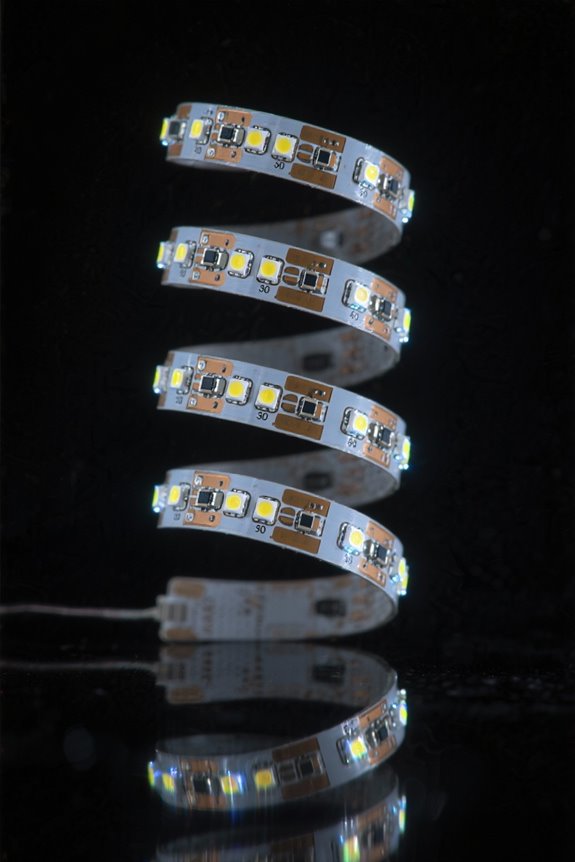
Recent advancements in SMD chip technology, particularly with the 3014 and 3020 models, have paved the way for a deeper exploration of the factors influencing LED strip performance. LED strip density greatly impacts brightness; higher density of LED chips, such as 120 LEDs/m, provides superior visual uniformity compared to standard options like 30 or 60 LEDs/m. However, this increased density correlates with higher power consumption—exceeding 9.6W/m for dense strips. Effective heat dissipation is essential to prevent premature LED failure and maintain energy efficiency. Additionally, the Color Rendering Index (CRI) can vary based on chip density, influencing light quality. Finally, compatibility with dimming systems can enhance performance, ensuring ideal functioning without flickering—something every homeowner appreciates. Similar to modern gaming monitors, high refresh rates in LED strips can significantly reduce motion blur and create smoother visual transitions during dynamic lighting effects.
Applications for High-Density LED Strips
High-density LED strips, which often feature 120 LEDs/m or more, find extensive applications in various settings, particularly where lighting quality and uniformity are vital. They excel in task lighting, especially in commercial kitchens, where even light distribution is fundamental to enhance productivity and safety. With lumen outputs exceeding 1800 lumens/m for 120 LEDs/m 2835 strips, these lights are capable of providing intense illumination for professional workspaces. Moreover, high-density LED strips are essential in architectural lighting, creating striking visual effects through uniform brightness. Their vibrant output makes them ideal for retail displays, effectively highlighting products to boost customer engagement. In photography and videography, they guarantee consistent lighting, minimizing shadows and reflections necessary for high-quality output. Similar to modern eye-caring LED technology found in gooseneck desk lamps, these strips help reduce eye strain during extended periods of use.
Choosing the Right LED Strip for Your Project
What factors should be prioritized when choosing the right LED strip for a project? First, consider the type of SMD LED chips; SMD 5050 is ideal for vibrant RGB applications with high brightness, while SMD 3528 provides softer accent lighting. Next, evaluate LED density, as higher counts—over 120 LEDs per meter in high-density strips—yield more consistent brightness and superior lumens per foot, necessary for task lighting. Also, check compatibility with dimming systems; high-density strips need robust drivers to prevent flickering. Finally, distinguish your application needs: high-density strips are perfect for professional use demanding even light distribution, whereas standard-density strips suffice for decorative purposes. Balancing these factors guarantees maximum performance for your specific project goals. For optimal visibility during detailed tasks, consider that modern LED strips can achieve 1300 lumens of brightness, matching the output of high-quality desk lamps.
Frequently Asked Questions
Which SMD LED Is the Brightest?
The SMD 5630 LED is recognized as the brightest, showcasing superior SMD efficiency comparison and LED power consumption. Its effective LED heat management and suitability for various applications demonstrate its advanced SMD manufacturing processes and durability factors.
Which Is Better SMD 5050 or 5630 LED?
SMD 5630 excels in brightness, yet SMD 5050 offers versatility. A thorough SMD features comparison reveals energy efficiency, longevity, and heat emission differences vital for application suitability, while cost and flexibility impact installation and overall performance.
Which Is Brighter, 4000K or 6000K?
Regarding brightness, 6000K cool white LEDs are typically perceived as brighter than 4000K warm white LEDs. This distinction influences application areas, mood setting, and eye comfort while considering energy efficiency for indoor and outdoor lighting.
Which LED Strip Lights Are the Brightest?
The brightest LED strip lights utilize high SMD chip technology, achieving superior lumens ratings. Their power consumption varies, offering options for various applications. Dimming capabilities, waterproof options, and energy efficiency benefits enhance installation flexibility and effectiveness.


