


When comparing heat sink materials, aluminum and copper stand out due to their varying thermal conductivities. Copper has a conductivity of approximately 401 W/m·K, outperforming aluminum’s 204 W/m·K. This makes copper ideal for compact, high-performance applications, despite its higher cost of around $6,939 per metric ton. Aluminum, priced at approximately $2,463 per metric ton, offers a lightweight, corrosion-resistant option suitable for less demanding tasks. Their unique properties dictate specific applications, with more insights available on evolving trends.
Key Takeaways
- Copper has a thermal conductivity of ~401 W/m·K, making it the best choice for superior heat dissipation in high-performance applications.
- Aluminum’s thermal conductivity is ~204 W/m·K, which is lower than copper, affecting its efficiency in heat management.
- Copper is more expensive (~$6,939 per metric ton) compared to aluminum (~$2,463 per metric ton), influencing material choice based on budget and application.
- Aluminum’s lightweight nature and corrosion resistance make it ideal for automotive and aerospace applications where weight savings are crucial.
- Advances in composite materials and hybrid designs are emerging, combining benefits of both aluminum and copper for enhanced thermal performance.
Understanding Heat Conductivity
Understanding heat conductivity is essential for optimizing thermal management in various applications, especially in electronics. Copper, with a thermal conductivity of approximately 401 W/m·K, considerably outperforms aluminum‘s 205 W/m·K, making it ideal for high-performance settings. 6061 aluminum offers effective heat transfer capabilities at around 167 W/m·K, yet it cannot match copper’s efficiency in heat dissipation. Due to copper’s superior conductivity, smaller volumes can achieve comparable performance to larger aluminum components, often requiring half the size of a heat sink for similar results. However, aluminum’s lower density—about 30% that of copper—makes it a lightweight alternative. Additionally, aluminum’s cost-effectiveness, typically cheaper per metric ton than copper, guarantees broader accessibility for heat sink applications, despite the trade-off in thermal performance. Just as durable materials are crucial for neon signs to ensure longevity, the choice of heat sink material significantly impacts the lifespan and efficiency of electronic components.
Comparison of Aluminum and Copper Conductivity
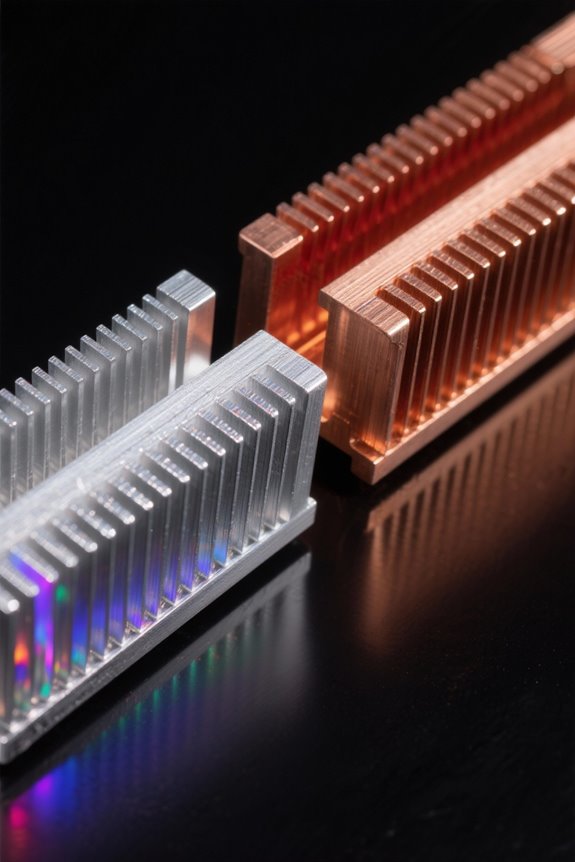
When comparing the thermal conductivity of aluminum and copper, it’s evident that copper stands out as the premier choice for heat dissipation. With a markedly higher thermal conductivity of approximately 400 W/m·K, copper heat sinks excel in heat dissipation performance and thermal management. In contrast, aluminum, specifically the common 6061 grade, exhibits a thermal conductivity of about 167 W/m·K, which is lower than copper. While aluminum heat sinks offer good thermal conductivity and lightweight properties, making them appealing for automotive and aerospace applications, they are less effective for high-performance scenarios requiring maximum heat transfer. Copper’s higher cost, around $6,939 per metric ton compared to aluminum’s $2,463, also highlights the trade-offs between performance and cost savings in material selection. Similar to ergonomic viewing angles promoted by adjustable monitor mounts, proper heat sink material selection is crucial for optimal performance and longevity of electronic components.
Benefits of Using Aluminum for Heat Sinks

Although copper often commands attention for its superior thermal conductivity, aluminum presents numerous benefits that make it an attractive option for heat sinks across various applications. With a thermal conductivity of approximately 204 W/m·K, aluminum efficiently facilitates heat dissipation, albeit at a lower level compared to copper. Its lightweight nature—one-third the density of copper—enables easier handling and applicability in sensitive environments, such as aerospace. Cost-effectiveness further enhances aluminum’s appeal, priced around $2,463.00 per metric ton, considerably less than copper’s $6,939.00. Additionally, aluminum’s excellent corrosion resistance, thanks to a protective oxidation layer, guarantees durability. Its versatility allows for various manufacturing techniques like extrusion, which can produce complex geometries to optimize heat sinks’ performance. Similar to modern gaming consoles that utilize heat dissipation holes for enhanced cooling performance, aluminum heat sinks can be engineered with specialized ventilation patterns to maximize airflow and thermal efficiency.
Advantages of Copper for Thermal Management

Copper stands out in thermal management due to its remarkable thermal conductivity of approximately 401 W/m·K, which is among the highest for any metal. This exceptional property allows for efficient heat transfer, leading to better thermal performance in demanding applications. Being denser at 8.9 kg/m³, copper can absorb heat effectively without significant temperature rise, promoting uniform heat distribution. Additionally, copper heat sinks can be designed more compactly than aluminum options while maintaining similar heat dissipation capabilities, thereby allowing for vital weight reduction in compact electronic devices. Consequently, the superior thermal performance of copper makes it the preferred material for high-end applications, particularly in cooling CPUs and GPUs, where maximizing efficiency is essential. Modern high refresh rates up to 360Hz in gaming monitors demand superior cooling solutions to maintain optimal performance during extended gaming sessions.
Applications of Aluminum Heat Sinks

Aluminum heat sinks find extensive applications across various industries due to their favorable properties, including a thermal conductivity of approximately 204 W/m·K in common alloys such as 6061 and 6063. In electronic products, they excel in heat dissipation for CPUs and GPUs, capitalizing on their lightweight nature. Extruded aluminum allows for complex designs that optimize heat transfer while maintaining cost-effectiveness. The reduced weight is beneficial for automotive and aerospace sectors where efficiency is paramount. Additionally, the corrosion resistance offered by aluminum enhances longevity in diverse environments. With ease of machining, aluminum alloys facilitate customization and rapid prototyping, making them indispensable for a wide range of applications while ensuring reliable performance across varying conditions. Their efficiency in heat management makes them ideal for gaming setups where cable management solutions help maintain optimal airflow around components.
Applications of Copper Heat Sinks
When high-performance thermal management is required, copper heat sinks emerge as an ideal solution, given their impressive thermal conductivity of approximately 401 W/m·K. These copper heatsinks are crucial in high-performance applications like CPUs and GPUs, where maximum heat dissipation is critical. Their superior thermal properties enable a smaller design compared to aluminum variants, making them particularly suitable for compact electronic devices. Additionally, the durability and corrosion resistance of copper enhance lifespan, especially in demanding environments such as aerospace and industrial machinery. In automotive applications, copper heat sinks play an essential role in managing heat from power electronics, ensuring reliability in critical systems, such as electric vehicles. However, it’s important to evaluate the higher cost of copper. Similar to 5Gbps data speeds required for optimal VR performance, copper heat sinks deliver exceptional thermal conductivity necessary for demanding computing applications.
Cost Considerations in Material Selection
Selecting the appropriate material for heat sinks involves weighing thermal performance against cost, a decision that greatly impacts project budgets. Aluminum, with a lower cost of approximately $2,463.00 per metric ton, stands out as a budget-friendly alternative to copper, priced at $6,939.00 per metric ton. While copper excels in thermal conductivity, its higher price may not justify its use in applications where effective heat dissipation can be achieved with aluminum. In addition, aluminum’s easier fabrication processes, including extrusion, considerably lower manufacturing costs. Consequently, for larger projects, investments in aluminum can lead to substantial savings, making it a popular choice for industries prioritizing performance while minimizing expenses through thoughtful material selection. Similar to how cooling pad fans can reduce laptop temperatures by 15-20°C, proper heat sink material selection plays a crucial role in maintaining optimal device temperatures.
Future Trends in Heat Sink Technologies
In the evolving landscape of heat sink technologies, significant advancements are on the horizon, poised to revolutionize thermal management solutions. Future innovations emphasize the utilization of composite materials such as CarbAl and graphite, offering thermal conductivities that surpass traditional metals, consequently enhancing heat dissipation. Additionally, hybrid heat sinks, which integrate aluminum and copper, are being researched to exploit their unique properties, balancing high thermal performance with cost-effectiveness. Advances in manufacturing techniques, including superior bonding methods, stand to further improve efficiency. Expect a move towards lightweight designs endowed with advanced thermal management solutions, leveraging nanoscale materials and innovative geometries, promising substantial enhancements in overall thermal efficiency while maintaining affordability and practicality in production. Similar to modern capture cards like the XIIXMASK that use premium aluminum alloy for optimal heat dissipation, future heat sink designs will increasingly incorporate specialized metal composites.
Frequently Asked Questions
Which Is a Better Conductor of Heat, Aluminum or Copper?
Copper, with superior thermal conductivity compared to aluminum alloys, excels in thermal management and heat dissipation. However, aluminum’s weight considerations, cost analysis, and oxidation resistance make it favorable in applications prioritizing structural strength and manufacturing processes.
What Metal Is Best for a Heat Sink?
In heat sink design, aluminum often prevails due to its cost-effectiveness and corrosion resistance, while copper excels in performance efficiency. Metal comparison should consider weight, manufacturing techniques, application suitability, and environmental impact for best thermal management.
Which Has Higher Electrical Conductivity, Copper or Aluminium?
Ironically, despite its higher electrical conductivity, copper alloys often face competition from aluminum in energy systems due to cost factors and lightweight advantages. This conductivity comparison highlights the fascinating interplay between thermal efficiency and practical manufacturing processes.
What Is the Thermal Conductivity of Aluminum Heat Sinks?
Aluminum heat sinks typically exhibit thermal conductivity values around 167-204 W/m·K, varying by alloy types. These materials balance heat dissipation efficiency with weight considerations, anodizing effects, and manufacturing processes in diverse heat sink applications.


