


Cat5e Ethernet cables support speeds up to 1 Gbps over 100 meters, operating at a frequency of 100 MHz. In contrast, Cat6 cables deliver up to 10 Gbps for distances of 55 meters, featuring a higher frequency of 250 MHz. Cat8 takes it a step further, offering 40 Gbps over 30 meters at an impressive 2000 MHz. Don’t get me wrong—choosing the right cable can enhance your network performance noticeably. Explore further to discover essential considerations for your network setup.
Key Takeaways
- Cat5e supports speeds up to 1 Gbps over 100 meters, suitable for basic networking needs.
- Cat6 allows speeds of up to 10 Gbps for distances up to 55 meters, ideal for high-bandwidth activities.
- Cat8 offers a remarkable speed of 40 Gbps over 30 meters, perfect for data-intensive applications in short-range environments.
- Real-world performance can be hampered by cable quality; poorly made cables can diminish the maximum speeds stated for each category.
- Upgrading from Cat5e to higher categories like Cat6 or Cat8 can significantly improve network performance and future-proof infrastructure.
Understanding Ethernet Cable Categories
When considering the various Ethernet cable categories, it becomes essential to understand the distinct capabilities and specifications each offers. Cat5e, suitable for basic networking applications, supports data transfer speeds of up to 1 Gbps with a frequency of 100 MHz. In contrast, Cat6 remarkably enhances performance, enabling speeds up to 10 Gbps for distances of 55 meters and operating at 250 MHz. The latest standard, Cat8, is engineered for short-range applications, delivering a remarkable 40 Gbps over just 30 meters while functioning at a frequency of 2000 MHz. Importantly, higher category Ethernet cables, such as Cat6 and Cat8, incorporate advanced shielding to mitigate crosstalk and electromagnetic interference, optimizing performance for future technological demands. Similar to how Hall Effect Technology enables ultra-precise movement in modern flight sticks, these advanced Ethernet categories utilize sophisticated engineering to achieve superior data transmission accuracy.
The Speed Capabilities of Cat5e

The speed capabilities of Cat5e Ethernet cables represent a solid entry point for basic networking needs. Cat5e is rated for maximum transmission speeds of 1 Gbps (1000 Mbps) over distances of up to 100 meters. With a frequency capacity limited to 100 MHz, these cables effectively reduce crosstalk and electromagnetic interference compared to earlier cable categories, ensuring a more stable connection. This improvement also makes Cat5e suitable for applications requiring Power over Ethernet (PoE), allowing both data and power delivery to devices like IP cameras. However, while Cat5e meets general internet usage demands, it might become a bottleneck in high-speed environments, necessitating the consideration of superior cables like Cat6 for robust performance and higher data rates. Similar to how surge protection ratings vary significantly between power strips to accommodate different needs, Cat5e cables offer varying levels of shielding and performance quality depending on the manufacturer and intended use case.
Cat6: A Step Up in Performance
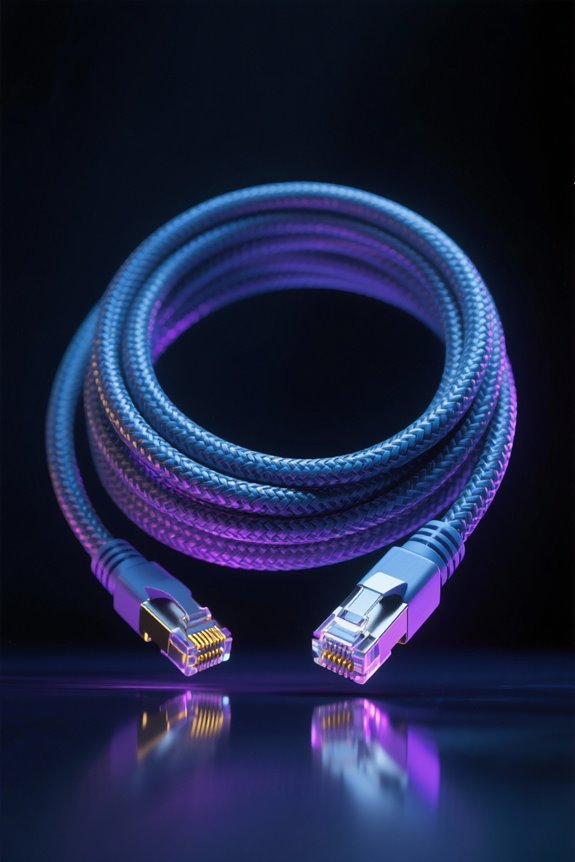
As network demands continue to rise, Cat6 Ethernet cables emerge as an essential upgrade for users seeking enhanced performance over Cat5e. Designed to support data rates of up to 10 Gbps for distances up to 55 meters, Cat6 cables markedly outpace Cat5e’s 1 Gbps cap over 100 meters. Operating at a frequency of 250 MHz, the Cat6 cable’s increased bandwidth allows for more efficient data transmission. The tighter twist and thicker gauge reduce crosstalk and electromagnetic interference, minimizing signal loss and ensuring superior signal quality. Ideal for high-traffic environments, Cat6 is perfect for applications requiring high speeds, such as video conferencing and gaming. With competitive pricing, upgrading infrastructure with Cat6 becomes a cost-effective solution. Similar to how Elite Series 2 controllers offer superior precision for gaming, Cat6 cables deliver enhanced performance for demanding network applications.
Cat8: The High-Speed Contender
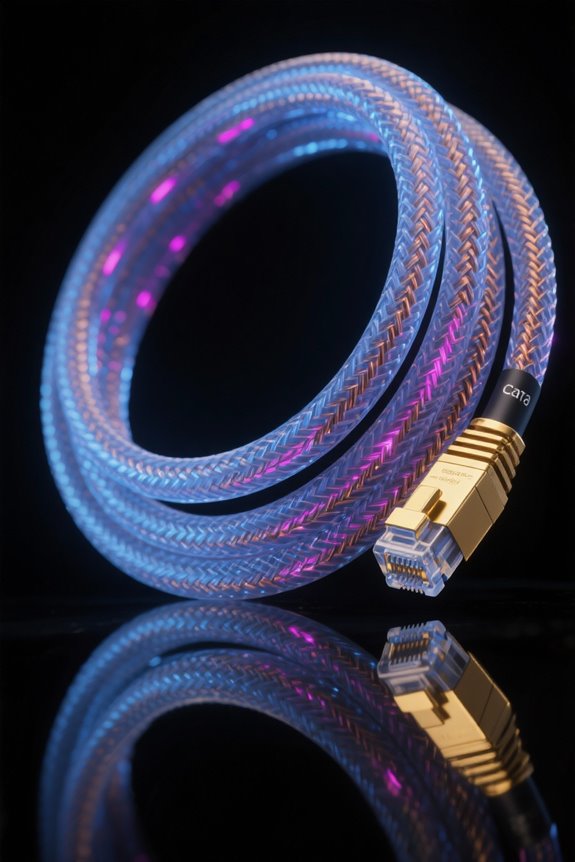
Cat8 Ethernet cables represent a considerable advancement in networking technology, particularly for organizations that demand the highest data transfer speeds. Capable of supporting speeds up to 40 Gbps over short distances of 30 meters, CAT8 cables excel in high-speed internet applications, especially within data centers. Boasting a remarkable bandwidth capacity of 2000 MHz, these cables considerably outperform both Cat5e and Cat6, making them suitable for very high-speed data transmissions. All CAT8 cables feature shielded twisted pair (S/FTP) construction, effectively minimizing electromagnetic interference for reliable signal quality. Though more expensive than their lower-category counterparts, the investment in Cat8 cables is justified by the need for superior performance in high-density environments, such as cloud computing or large-scale virtual networks. Similar to modern USB-C connections, these cables deliver exceptional data transfer speeds that can significantly enhance gaming and data-intensive applications.
Comparing Bandwidth and Frequency Specifications

Bandwidth and frequency specifications are essential elements in evaluating Ethernet cables, particularly when selecting the right option for specific networking needs. Cat5e supports a maximum bandwidth of 100 MHz, allowing data transmission speeds of up to 1 Gbps over distances of 100 meters. In contrast, Cat6 boasts a bandwidth capacity of 250 MHz, enabling 1 Gbps speeds over the same distance and up to 10 Gbps for distances reaching 55 meters. Cat8 takes a significant leap, offering a remarkable bandwidth of 2000 MHz, translating to speeds of 40 Gbps over 30 meters. The higher frequency ratings of Cat6 and Cat8 result in reduced crosstalk and minimal electromagnetic interference, enhancing data integrity. Don’t get me wrong, these specifications can make a substantial difference in performance. Similar to modern DisplayPort cables that utilize triple shielding for interference protection, high-end Ethernet cables employ advanced shielding techniques to maintain signal quality.
Distance Limitations Across Categories
While it may seem that all Ethernet cables can deliver high-speed connections across similar distances, the reality is that performance greatly varies with each category. Cat5e offers maximum speeds of 1 Gbps over the full 100 meters, making it suitable for basic networking needs. In contrast, Cat6 can achieve 10 Gbps speeds but only up to 55 meters; beyond that, you’re limited to 1 Gbps at 100 meters, which can be essential if distance is a factor in your setup. Meanwhile, Cat8, designed for short distances, excels with speeds reaching 40 Gbps but only up to 30 meters, making it ideal for data centers rather than typical office use. Consequently, understanding these distance limitations is vital for optimizing network performance. For optimal signal quality and reduced latency across any category, experts recommend using shorter cable lengths under 25 feet whenever possible.
Shielding: Why It Matters
When considering networking solutions, the importance of shielding in Ethernet cables cannot be overstated. Shielding in Cat6 and Cat8 cables considerably reduces electromagnetic interference (EMI) and crosstalk, enhancing signal integrity essential for efficient data transmission. Unlike Cat5e, which is generally unshielded, Cat6 and Cat8 boast superior shielding options—like shielded twisted pair (STP) or screened twisted pair (S/FTP). The latter provides minimal signal loss, accommodating speeds of up to 40 Gbps over short distances. Poor shielding could result in significant data degradation in noisy environments with multiple electronic devices. Consequently, understanding the types of shielding available is vital for selecting cables that meet high-demand networking needs, ensuring ideal performance under varying conditions. Similar to sound dampening blankets that effectively filter out unwanted noise, proper cable shielding helps maintain signal clarity by blocking external interference.
Cost Considerations for Each Category
Cost plays a significant role in selecting the right Ethernet cable for specific networking needs. Cat5e cables are the most affordable choice, typically priced at around $0.15 to $0.20 per foot, making them suitable for basic applications. In contrast, Cat6 cables, offering enhanced performance capabilities and supporting 10 Gbps over short distances, range from $0.30 to $0.50 per foot. Cat8 cables, designed for high-demand scenarios like data centers, come at a higher cost, usually between $1 to $2 per foot. When considering installation, it’s important to factor in long-term savings; investing in higher-category cables may reduce future upgrade needs, especially in environments anticipating growing bandwidth requirements. Ultimately, cost considerations are essential for lasting efficiency. For optimal organization, using cable management sleeves can protect your investment while maintaining a clean and professional workspace appearance.
Practical Applications for Home and Office Networks
In today’s fast-paced digital landscape, choosing the right Ethernet cable can greatly enhance the efficiency of home and office networks. Cat5e is suitable for basic home networking and low-bandwidth applications, supporting up to 1 Gbps over 100 meters. For those needing higher performance, Cat6 offers a maximum speed of 10 Gbps at lengths up to 55 meters, making it ideal for environments with multiple connected devices or high-definition streaming. Cat8, while designed for short distances, delivers outstanding speeds of up to 40 Gbps over 30 meters, perfect for data-intensive settings. In office networks, relying on Cat5e may suffice for simple tasks, but upgrading to Cat6 or Cat8 is advisable for efficient bandwidth management, especially during video conferencing or large file transfers. When setting up a gaming station, proper cable management is essential, and many modern L-shaped gaming desks feature built-in power outlets and cable organization systems to maintain a clean, efficient workspace.
Future-Proofing Your Network Infrastructure
Upgrading networking equipment requires foresight, especially as digital demands continue to escalate. Future-proofing your network infrastructure is essential; opting for cables such as Cat6, capable of 10 Gbps, or Cat8, which supports up to 40 Gbps, can greatly enhance performance. Shifting from Cat5e to Cat6a remarkably improves capabilities in environments needing 10 Gigabit Ethernet. To address high-density requirements, Cat8 is an asset for data centers, providing robust performance over short distances. As IoT devices and cloud services proliferate, installing higher category cables minimizes the risk of obsolescence, ensuring your network remains compatible with advancing technologies. Making these decisions now reinforces your network infrastructure’s readiness for increased device connectivity and next-generation applications. Similar to how dual monitor KVMs enhance productivity through efficient multitasking, upgrading to higher category cables empowers your network to handle increasing data demands seamlessly.
Impact of Ethernet Cable Quality on Internet Speed
While many factors influence internet speed, the quality of Ethernet cables stands out as a crucial element that can markedly enhance performance. High-quality cables like Cat6 and Cat8 provide superior signal integrity compared to lower-grade options such as Cat5e. For instance, Cat6 supports data transfer speeds of up to 10 Gbps over distances up to 55 meters, while Cat8 excels with speeds of up to 40 Gbps, albeit over 30 meters. The use of higher purity copper conductors minimizes resistance and attenuation, directly impacting overall network speeds. Poor-quality cables can lead to significant signal loss and interference, hampering internet performance. Consequently, investing in premium Ethernet cables is essential for achieving peak data transfer speeds in any network setup.
Choosing the Right Cable for Your Needs
Choosing the right Ethernet cable is critical to achieving ideal network performance, particularly as the demands of technology continue to evolve. For basic networking needs, Cat5e supports speeds of up to 1 Gbps over distances of 100 meters, making it a cost-effective choice. When upgrading to more demanding tasks, Cat6 is preferable, offering data transmission rates of 10 Gbps for runs up to 55 meters—perfect for home networks and small offices. For high-performance environments like data centers, Cat8 shines with speeds reaching 40 Gbps over shorter distances of 30 meters. Consequently, when choosing the right cable, consider your current applications and future-proofing your setup; investing in higher category cables guarantees that your network can keep pace with evolving technology and internet speeds.
The Importance of Connector Compatibility
How can proper connector compatibility affect the efficiency of your network? Connector compatibility is essential for ensuring seamless integration of various network devices. While both Cat6 Ethernet cables and CAT8 Ethernet typically utilize RJ45 connectors, the latter may require high-quality connectors to support its advanced performance specifications. When outdated or incompatible connectors are used, data transfer speeds can plummet, leading to increased latency and overall network inefficiency. For installations employing Power over Ethernet (PoE), high-category cables like Cat6 and Cat8 demonstrate superior electrical characteristics, reducing resistance and heat. Consequently, ensuring the right connector type and quality is imperative, as poor connections may result in signal loss and crosstalk, ultimately compromising network reliability and speed.
Frequently Asked Questions
Is Cat8 Faster Than CAT5E?
Certainly, when it comes to Ethernet applications, Cat8 outshines Cat5e, embodying a robust future-proofing technology. Its superior cable shielding enhances network infrastructure, making installation considerations pivotal for those seeking peak performance and reliability.
Is Cat8 Worth It Over Cat6?
Cat8 is worth it over Cat6 for those prioritizing network performance and future-proofing. However, the benefits must be weighed against installation costs, as Cat6 adequately meets most typical needs without requiring significant financial investment.
Is Cat8 Overkill for Home Use?
Indeed, Cat8 may be seen as overkill for home use, as its installation costs and cable length impact outweigh potential gains. Future proofing concerns diminish when existing speed testing methods reveal sufficient home network efficiency with Cat6.
Is Cat8 Overkill for Gaming?
Cat8 may be considered overkill for gaming performance, as its advantages in cable shielding and future-proofing do not outweigh higher installation costs. Network latency remains more influential on gameplay, rendering Cat6 a more practical choice.


