


Boom arm designs leverage cantilever and spring-loaded principles to optimize performance in diverse applications. Cantilever arms, fixed at one end, offer rigidity and minimal deflection under load, supporting significant weight. Conversely, spring-loaded systems use stored energy to enable quick, efficient, and compact actuation. For instance, cantilevers may handle loads exceeding 100 pounds, while spring mechanisms can release energy in milliseconds. Don’t get me wrong; both designs have unique benefits and trade-offs. Continue on to uncover further insights into their functionalities.
Key Takeaways
- Cantilever designs provide high rigidity and minimal deflection under load, ideal for applications requiring stable support, like balconies and bridges.
- Spring-loaded mechanisms store energy in springs, enabling quick actuation and movement with low external power requirements.
- Material selection is crucial; cantilevers often use robust metals, while spring-loaded designs benefit from lightweight composites to enhance portability.
- Future trends include modular designs, smart sensors, and hybrid systems combining the advantages of both cantilever and spring-loaded technologies.
- Technological advancements, such as noise-canceling features, are enhancing the performance and operational functionality of boom arms across diverse applications.
Understanding Cantilever Beam Design
When considering the design of cantilever beams, one must recognize their unique structural properties that allow them to function effectively. A cantilever beam is fixed at one end and extends horizontally without vertical supports, which permits innovative architectural designs. The fixed support absorbs bending moments and shear forces, requiring meticulous load analysis to account for both live and dead loads. Significantly, the free end deflects under load, mandating strict adherence to deflection limits to guarantee structural integrity and visual appeal. Materials such as steel, concrete, and timber can be employed, each presenting distinct advantages. Additionally, effective cantilever beam design prioritizes durable fixed ends to counteract loads, maximizing weight efficiency while maintaining resilience against applied forces. Similar to the open-back design principle used in premium gaming headsets, cantilever structures must carefully balance weight distribution and structural support to achieve optimal performance.
Basics of Spring-Loaded Mechanisms

Spring-loaded mechanisms are essential components in numerous applications, enabling efficient energy storage and rapid actuation. These systems operate by utilizing a spring to store energy, which is released to move an attached component. The spring constant plays a vital role, as stiffer springs deliver greater force and faster responsiveness, though they demand more energy for compression or extension. Additionally, various designs allow for quick movement with minimal external power, making them ideal for actuation and deployment systems. However, spring-loaded mechanisms can face fatigue over time, necessitating careful material selection for durability. The effectiveness of these mechanisms is typically evaluated using parameters like force output and response time, aligning them with specific operational needs, ensuring reliable performance in demanding environments. Similar to the high-density memory foam used in premium gaming chairs, spring-loaded mechanisms must provide consistent support and maintain their shape under repeated use.
Load Management in Cantilever Systems

Effective load management in cantilever systems is essential for ensuring structural integrity and performance under various load conditions. These systems typically support loads with one end fixed, necessitating a thorough analysis of both live and dead loads. The maximum stress occurs at the fixed support, directly proportional to the applied load, while deflection often follows a cubic relationship to load and beam length. To minimize deformation, material choice—be it steel, concrete, or composite—must provide sufficient strength and rigidity, adhering to established deflection limits. Building codes dictate these limits for safety and aesthetics, reminding users that balanced load management not only supports functionality but also prevents potential failure modes like buckling and excessive bending. Similar to how the Hall Effect joysticks in modern gaming controllers provide precise control through magnetic sensing, cantilever systems require exact calculations to maintain optimal performance under varying loads.
Energy Storage in Spring-Loaded Systems
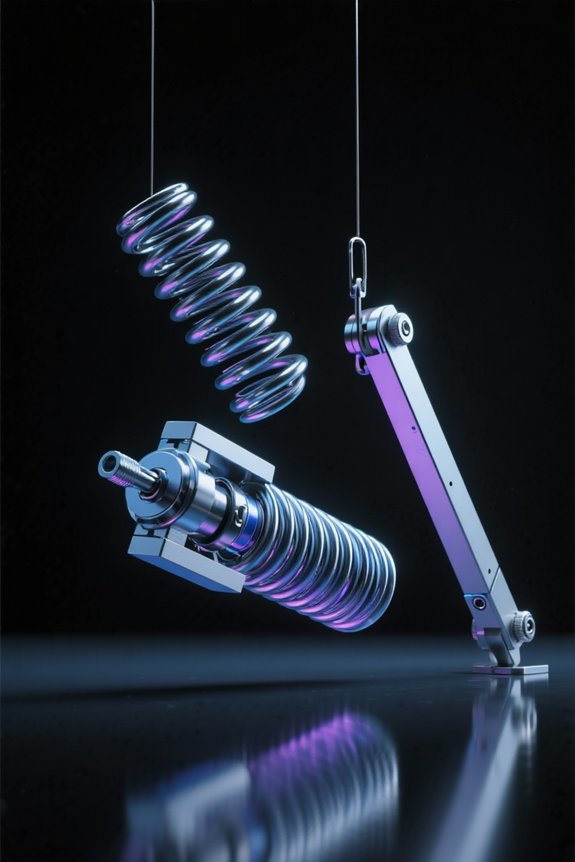
Harnessing the potential of energy storage systems can considerably enhance the functionality of boom arms, particularly in dynamic applications. Spring-loaded systems operate by converting potential energy, stored through the manipulation of a spring, into kinetic energy upon release. This dynamic movement allows for rapid deployment. The energy stored can be quantified using the formula \(E = rac{1}{2} k x^2\), where \(k\) represents the spring constant and \(x\) denotes the spring’s displacement. Additionally, friction at hinge points and material fatigue can influence energy efficiency. By varying spring constants, designers can tailor the forces exerted, addressing specific operational needs. Furthermore, these mechanisms facilitate quick structure deployment in spaces, promoting efficient instrument operation while minimizing continuous power requirements. The dual suspension springs utilized in models like the SUNMON QuadCast demonstrate how this energy storage principle enables stable, professional-grade recordings.
Applications of Cantilever Designs

Cantilever designs exemplify innovative engineering solutions that maximize efficiency across various applications. These structures provide essential support for balconies, allowing architects to create extended floor spaces without the need for obstructive vertical supports. In the field of civil engineering, cantilever bridges enable longer spans, enhancing aesthetics and functional capabilities. Highway signs frequently utilize cantilever designs, positioned strategically over roadways to maintain clear pathways below, ensuring safety and visibility. In warehouses, cantilever shelving systems optimize storage by eliminating multiple vertical supports that can restrict access. Additionally, in aerospace applications, cantilever arms extend instruments beyond a spacecraft’s confines, proving invaluable for mission operations. Each of these applications showcases the versatility and practicality of cantilever designs in modern engineering. Modern desk lamps often employ adjustable gooseneck arms that function as miniature cantilevers, allowing precise positioning of light sources over work surfaces.
Applications of Spring-Loaded Designs
Innovative engineering often leads to new applications of spring-loaded designs, particularly in the domain of deployable mechanisms. These systems are extensively utilized in spacecraft, ensuring efficient storage and deployment of instruments like communication antennae and solar panels. By utilizing the stored potential energy in a compressed spring, rapid deployment is achieved, often critical in space applications. Spring-loaded designs markedly reduce reliance on complex actuators, which lessens overall weight—critical for spacecraft, as every gram counts. Additionally, these mechanisms require minimal human intervention for deployment, ensuring reliability during critical missions. In cantilevered structures, spring-loading helps counterbalance deployed components’ weight, enhancing stability. Such designs illustrate the versatility and effectiveness of spring-loading in technological advancements, especially in aerospace engineering. Similar to VR equipment that can withstand 10,000 cable bends, spring-loaded mechanisms are engineered for exceptional durability and longevity.
Advantages and Disadvantages of Each Design
While both cantilever and spring-loaded designs present unique advantages and challenges, understanding these can significantly impact design decisions in engineering projects. Cantilever designs excel in structural simplicity, supporting heavy loads at a fixed point, which is ideal for stable applications like satellite booms. However, they may experience significant deflection, necessitating careful load analysis. On the other hand, spring-loaded designs offer dynamic deployment, allowing for tailored retraction and expansion, crucial where space is limited. Yet, they require complex mechanisms for actuation, making them more intricate. Both designs depend heavily on material choice—metallic for robustness in cantilevers and composites for lightweight spring-loaded options—highlighting the need for thorough fatigue and maintenance considerations for reliable operation in diverse environments. Modern microphone stands like the InnoGear models demonstrate these principles with their weighted base design that can support up to 4.4 pounds while minimizing unwanted vibrations.
Key Considerations for Design and Implementation
Precision in design and implementation is paramount when developing boom arms, as the effectiveness of these mechanisms hinges on multiple interrelated factors. When selecting between cantilever and spring-loaded designs for deployable booms, stability and flexibility must be considered. Cantilever designs, known for their high rigidity, excel in conditions requiring minimal deflection under load. Conversely, spring-loaded systems offer automatic retraction, making them ideal for rapid deployment in restricted environments. Material choice is critical; lightweight metals like aluminum or composite materials enhance strength-to-weight ratios. Additionally, thorough analysis is essential to guarantee structural integrity against external factors such as vibrations or thermal expansion. Don’t get me wrong, the right materials and design choices can considerably impact performance, ultimately leading to operational success. Implementing advanced isolation systems in the boom arm design significantly reduces unwanted vibrations and enhances overall sound clarity during professional recordings.
Future Trends in Boom Arm Technologies
What advancements are on the horizon for boom arm technologies? The future will see significant integration of advanced materials like composites and additive manufacturing to enhance durability and reduce weight in deployable structures, essential for space applications. Ongoing developments aim to automate deployment mechanisms, lessening reliance on manual activation through smart sensors and motorized systems. Enhanced simulation techniques, particularly refined finite element analyses, will predict performance under various conditions, thereby increasing safety. Additionally, modular boom systems will allow for customizable configurations to meet diverse mission needs. Research into hybrid designs, combining cantilever and spring-loaded systems, promises improved flexibility and strength, addressing concerns related to mechanical failure during deployment. These trends indicate a promising evolution in the capabilities of boom arm technologies. Modern innovations in boom arm design draw inspiration from gaming peripherals like the noise-canceling microphones that utilize advanced EMC technologies for optimal performance in various environments.
Frequently Asked Questions
What Are the Disadvantages of a Cantilever Structure?
Cantilever structures face disadvantages such as potential excessive deflection under heavy loads, increased material costs due to robust design requirements, stress concentrations leading to fatigue, and risks of buckling that compromise their weight limit capabilities.
What Are the Design Considerations for Cantilever Beam?
Design considerations for cantilever beams encompass load analysis, material selection, deflection limits, and robust fixed connections. These factors guarantee design stability, accommodating expected loads while preventing structural failure and maintaining functionality throughout the beam’s lifespan.
What’s the Difference Between Cantilever and Propped Cantilever?
In the world of structural support, a cantilever provides stability solely from a fixed end, while a propped cantilever enjoys additional backing at the other end, distributing loads more evenly and minimizing stress concentrations.
Where and Why Does a Cantilever Beam Fail First?
A cantilever beam typically fails first at the fixed support due to maximum bending moments and shear forces concentrated there. Stress concentration zones, material properties, and excessive deflection further contribute to failure location and likelihood of failure.