


NVMe and SATA SSDs differ greatly in performance. NVMe drives leverage PCIe connectivity and the NVMe protocol, achieving speeds over 3,500 MB/s, while SATA SSDs plateau at about 550 MB/s. This speed advantage allows NVMe to excel in gaming and video editing applications. SATA SSDs are more budget-friendly, priced around $50 to $100 for 500GB to 1TB, but may bottleneck in data-intensive tasks. If you seek deeper insights into their applications and value, there’s more to explore.
Key Takeaways
- NVMe SSDs achieve data access speeds around 3,500 MB/s, significantly outperforming SATA SSDs, which max out at approximately 550 MB/s.
- NVMe uses PCIe bus enabling higher parallelism with 65,535 command queues, reducing latency compared to SATA’s single command queue.
- SATA SSDs are suitable for everyday tasks, while NVMe excels in demanding applications like gaming and video editing due to superior speed.
- NVMe drives typically cost more than SATA SSDs, but offer better long-term value for high-performance needs.
- Compatibility is crucial, as not all systems support NVMe drives; check for proper keying and motherboard support before purchasing.
What Is an SSD?
At its core, a Solid-State Drive (SSD) represents a significant advancement in data storage technology. Utilizing NAND flash memory, SSDs provide non-volatile storage without the mechanical components prevalent in traditional hard disk drives (HDDs). This design allows for greater durability, reduced power consumption, and quieter operation. Regarding performance, SSDs boast impressive data access speeds and data transfer speeds; NVMe models often reach around 2000 MB/s, while SATA variants typically max out at approximately 550 MB/s. Common form factors include 2.5-inch SATA drives and M.2 drives, with M.2 NVMe options offering superior performance. The global NAND flash memory market reached about $68.4 billion in 2022, indicating the rising demand for SSD technology across diverse applications. Modern external enclosures equipped with thermal management systems help maintain optimal SSD performance during intensive data transfer operations.
Understanding SATA Technology
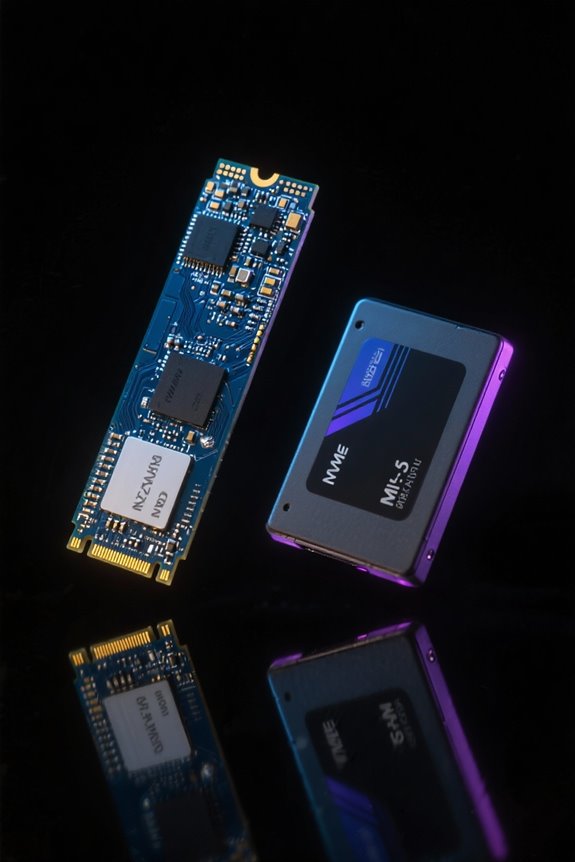
While SATA (Serial Advanced Technology Attachment) technology has been a foundational component in the evolution of data storage, it primarily serves to bridge the gap between traditional hard disk drives and modern solid-state drives. SATA III, launched in 2009, supports a maximum transfer rate of 6 Gb/s (approximately 600 MB/s), which, while an improvement over spinning hard drives, becomes a performance bottleneck for high-speed SSDs. Utilizing the AHCI (Advanced Host Controller Interface), SATA SSD performance is limited to a single storage request queue of 32 commands. M.2 SATA SSDs, designed for compact installations, still face this limitation, therefore falling short compared to their M.2 NVMe counterparts, which leverage PCIe for notably higher speeds, often exceeding 8,000 MB/s. Modern capture cards like the Elgato 4K X have embraced USB 3.0 standards to achieve faster data transfer rates than traditional SATA connections.
Understanding NVMe Technology
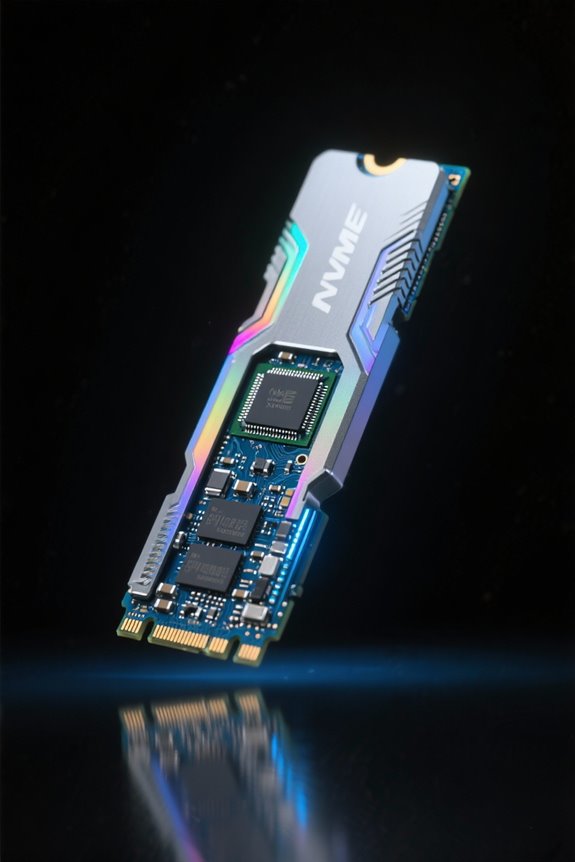
As technology evolves, NVMe (Non-Volatile Memory Express) stands out as a revolutionary protocol tailored for SSDs, providing remarkably faster data access speeds when compared to traditional interfaces such as SATA. This technology interfaces with storage devices via the PCIe bus, enabling theoretical transfer rates up to 64,000 MB/s and effective speeds of around 4 GB/s in M.2 form factors. NVMe technology supports an extraordinary depth of command queues—65,535 queues containing 65,536 commands each—greatly enhancing performance and reducing latency compared to SATA’s single command queue limitation. By eliminating the overhead associated with SATA’s Host Bus Adapter, NVMe allows direct communication between the SSD and CPU. Consequently, users benefit from exceptionally rapid response times, making NVMe ideal for demanding applications utilizing NAND flash memory. Similar to how ergonomic design features enhance comfort during extended computer use, NVMe’s advanced capabilities ensure optimal performance for prolonged computing sessions.
Comparing Performance: SATA Vs NVME
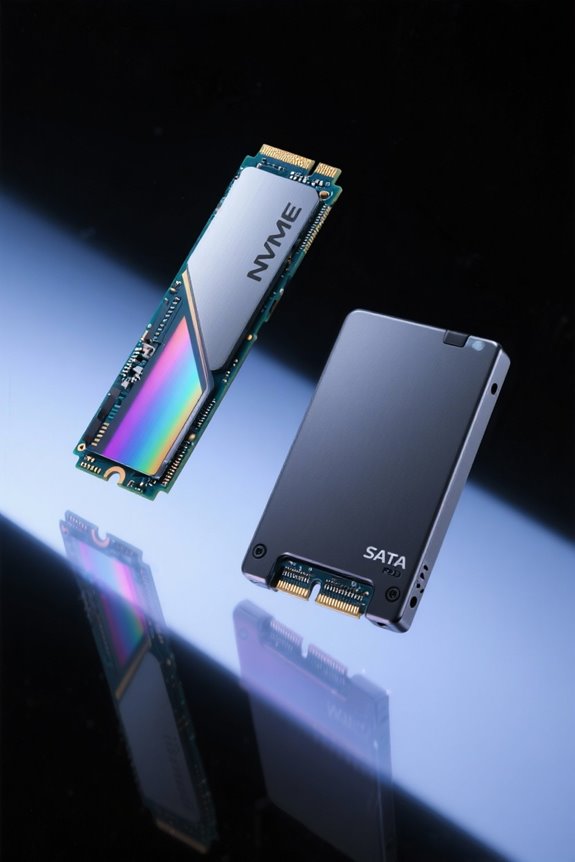
Performance disparities between NVMe and SATA SSDs are striking and merit careful analysis. NVMe SSDs leverage the PCIe interface, achieving impressive transfer speeds of up to 7,000 MB/s, while SATA SSDs are limited to approximately 550 MB/s due to the SATA III interface constraints. Regarding performance and latency, NVMe supports up to 64,000 command queues with 65,536 commands per queue, vastly exceeding the 32-command limit of SATA. Consequently, in demanding applications like gaming or video editing, NVMe’s architecture allows for better parallel processing, greatly enhancing read/write speeds. While SATA SSDs improve upon HDDs, delivering 10 to 15 times better performance, NVMe SSDs can be up to 10 times faster in real-world scenarios, emphasizing their growing superiority in the market. For content creators using external capture cards, the superior speed of NVMe SSDs ensures smoother recording and playback of high-resolution gaming footage at 4K resolution.
Speed and Transfer Rates

Speed and transfer rates serve as pivotal indicators when evaluating the differences between NVMe and SATA SSDs. NVMe SSDs can achieve theoretical transfer speeds of up to 20Gbps, markedly outpacing SATA SSDs, which top out at 6Gbps. The effective transfer rate for NVMe SSDs typically exceeds 3,500MB/s, contrasted with SATA’s limitations of around 550-600MB/s. This enhanced performance is largely due to NVMe’s utilization of multiple PCIe lanes for data transfer, compared to SATA’s single interface operation. Additionally, NVMe supports up to 65535 command queues with 65536 commands each, allowing much higher parallelism. Its reduced protocol latency contributes to quicker response times, making NVMe particularly suitable for bandwidth-intensive applications like gaming and professional data processing. For gaming applications specifically, the USB 3.0 technology offers rapid data transfer capabilities that bridge the performance gap between external storage solutions and internal drives.
Bandwidth and Throughput
While NVMe SSDs greatly outperform their SATA counterparts with respect to bandwidth and throughput, it is essential to grasp how these aspects impact user experience in practical applications. NVMe SSDs leverage the PCIe interface, achieving theoretical transfer speeds of up to 20Gbps and effective throughput reaching 4GB/s in M.2 form factors. In contrast, SATA SSDs are limited to a maximum of 6Gbps and 600MB/s, respectively. This disparity is evident in data-intensive tasks, like gaming and video editing, where NVMe’s superior throughput enhances performance markedly. Moreover, NVMe architecture supports up to 64,000 command queues, contrasting sharply with SATA’s single queue of 32 commands, additionally proving beneficial in real-world applications where speed and efficiency are vital. Modern gaming monitors with high refresh rates of up to 240Hz benefit significantly from NVMe’s enhanced data transfer capabilities, ensuring smoother gameplay and reduced loading times.
Parallelism in Data Processing
As modern computing demands increase, the ability to process data concurrently becomes pivotal, particularly in scenarios involving rich media and high-performance applications. NVMe SSDs exhibit remarkable parallelism, boasting 65535 command queues with 65536 commands each. In stark contrast, SATA SSDs operate with a single command queue limited to just 32 commands. This intrinsic architectural advantage allows NVMe to execute numerous input/output operations simultaneously, greatly enhancing data processing efficiency while reducing latency. With a queue depth accommodating 64,000, NVMe excels in handling thousands of concurrent read and write tasks, making it ideal for demanding applications like gaming. Consequently, the performance differences are pronounced, where NVMe can achieve throughput speeds up to 7,000 MB/s compared to SATA’s 550 MB/s. This superior speed and parallelism capability makes NVMe SSDs particularly well-suited for high refresh rate gaming monitors that demand rapid data processing for smooth gameplay performance.
Compatibility and Form Factors
Understanding the nuances of compatibility and form factors is vital for anyone considering the installation of SSDs in their systems. M.2 NVMe SSDs, with speeds reaching up to 3,500 MB/s, offer significant performance advantages over SATA SSDs, which are limited to around 550 MB/s. However, the compatibility of M.2 NVMe SSDs with older hardware can present challenges, as they demand specific motherboard support for PCIe connections and M.2 slots. In contrast, SATA SSDs usually connect effortlessly to any system with SATA ports. The M.2 form factor is advantageous for space efficiency, yet potential users must be aware of the keying differences—M key and B key—to guarantee proper installation. Careful consideration of these factors is imperative for peak performance. Similar to how high-strength carbon steel provides stability in racing wheel stands, robust materials and proper installation ensure reliable SSD performance.
Cost Comparison
When evaluating the cost of SSDs, it is essential to recognize the significant price differences between SATA and NVMe options. SATA SSDs are generally more budget-friendly, typically priced between $50 and $100 for capacities ranging from 500GB to 1TB. In contrast, NVMe SSDs often exceed $100 for similar capacities, reflecting their advanced technology and higher speeds. Remarkably, the cost per gigabyte decreases with larger storage capacities, presenting better deals for SATA models. However, despite the higher costs, NVMe SSDs deliver superior long-term value for performance-demanding applications, such as gaming and professional video editing. Ultimately, potential price fluctuations and seasonal discounts can impact the cost comparison, making it essential to monitor pricing trends carefully. Similar to how acoustic diffuser panels enhance sound quality in recording studios, NVMe SSDs provide premium performance for users seeking optimal system responsiveness.
Use Cases for SATA SSDs
SATA SSDs serve a variety of practical use cases, particularly for everyday computing tasks. They offer speeds of up to 550 MB/s, making them suitable for web browsing, document editing, and other general computing tasks. As a budget-friendly option, SATA SSDs provide significant performance improvements, achieving 10-15 times faster access than traditional hard drives. They are compatible with older systems and can be easily installed without specialized connectors, ensuring accessibility for many users. However, it’s essential to highlight that while SATA SSDs excel in basic applications, they may bottleneck performance in data-intensive applications like gaming or video editing, where faster transfer speeds are vital. Consequently, consider your needs when selecting storage solutions. For gaming enthusiasts seeking maximum performance, PCIe Gen4 technology offers read speeds up to 7,000 MB/s, significantly outpacing SATA capabilities.
Use Cases for NVMe SSDs
While many consumers benefit from SATA SSDs for everyday tasks, NVMe SSDs emerge as the go-to solution for those requiring superior performance in demanding scenarios. These drives excel in resource-intensive tasks, boasting data transfer rates exceeding 3,500 MB/s, making them indispensable for gaming, video editing, and 3D rendering. Their low latency enhances system responsiveness, crucial for applications that need real-time processing, such as virtual machines and large database transactions. Additionally, NVMe SSDs support 65535 command queues, improving multi-tasking efficiency compared to SATA SSDs, which are limited to a mere single queue. Businesses leveraging NVMe can reduce application load times by up to 90%, greatly boosting productivity in data-heavy environments. Don’t get me wrong; the performance differences are clear.
Choosing the Right SSD for Your Needs
Selecting the right SSD to match specific computing needs requires careful consideration of various factors. For resource-intensive applications such as gaming and video editing, NVMe SSDs are ideal, delivering speeds over 3,500MB/s, far exceeding SATA’s maximum 600MB/s. If budget constraints are your primary concern, SATA SSDs provide a more wallet-friendly option, improving performance considerably over traditional HDDs. Additionally, verify compatibility with your motherboard; not all systems support NVMe drives, which require specific PCIe slots. Storage capacity is another key factor; SSDs range from 120GB to several terabytes, with NVMe often offering higher performance per capacity. Balancing these variables ascertains you select the SSD that best meets your unique storage and performance requirements.
Frequently Asked Questions
What Is the Performance Difference Between SATA SSD and NVME SSD?
The performance difference between SATA and NVMe SSDs lies in speed comparisons, data transfer rates, boot times, and gaming performance. While NVMe excels in video editing and efficiency, cost and compatibility factors often influence user choices.
What Are the Disadvantages of NVME?
NVMe drives face disadvantages including higher cost, compatibility limitations, and thermal throttling issues. They also present firmware vulnerabilities, increased power consumption, limited availability, and lifespan variability, which can affect use case suitability and data loss risks.
Is It Worth It to Upgrade From SATA to NVME?
Upgrading from SATA to NVMe can reveal unparalleled gaming performance and future-proofing benefits, despite cost implications and installation requirements. However, one must navigate compatibility issues, heat management, and long-term reliability when considering their specific use case scenarios.
How Much Faster Is NVME Compared to SSD?
NVMe drives greatly outperform traditional SSDs, achieving over 7,000 MB/s compared to 550 MB/s. This speed comparison enhances gaming performance, improves workload efficiency, reduces boot times, and optimizes file transfers, despite notable price differences and potential thermal throttling challenges.


